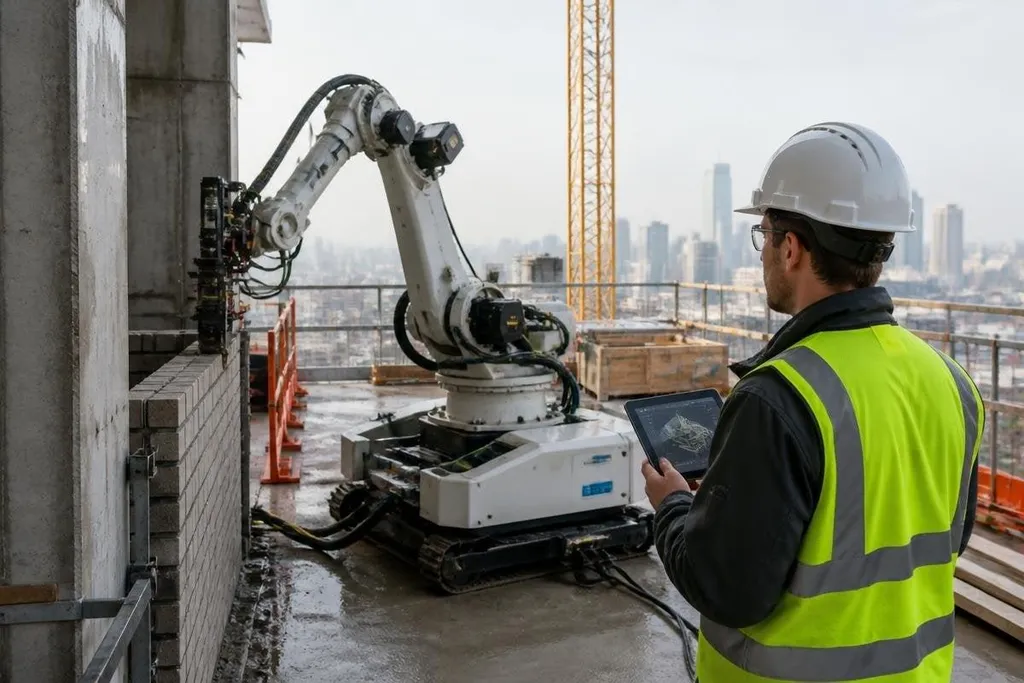
A skyscraper gives robots a difficult workplace: narrow floors, changing layouts, heavy parts, wind, dust, and people working nearby. Robots could take on repeated lifting, drilling, bricklaying, inspection, and material movement, but a full robot-built tower remains an engineering and planning problem.
Quick read
- Robots fit best into repeated tasks with fixed tools and clear safety zones.
- Construction sites change often, so machines need mapping, sensing, and human control.
- The first useful systems will likely support crews instead of replacing them.
Where robots could help first
A tower project repeats many jobs across many floors. That makes some work suitable for robots, especially when the task has a known path and a limited set of materials.
A mobile robot could carry tools or panels across a floor, while an arm fixed to a platform could drill holes, place fasteners, or apply material along a planned route.
A bricklaying system could place units in a pattern after workers prepare the surface and load the materials.
Inspection is another clear use. With cameras, LiDAR, or other sensors, the robot could scan walls, floors, pipes, and structural parts. The scan could show where work differs from the digital building plan, giving a supervisor a record to check before the next trade starts.
That matters because a small error on one floor can affect later work above it. Recording its position and the condition of the work gives the crew more information than a task finished with no digital record.
The tower changes while the robot works
Factory robots benefit from fixed floors, known objects, and controlled lighting. A construction site offers none of those conditions for long. A lift shaft may be open in the morning and covered later. Temporary barriers move. Materials arrive in different places. Workers and machines share the same space.
The robot would need a live map of its surroundings. Simultaneous localization and mapping, or SLAM, lets a system estimate its position while it builds that map. Cameras and LiDAR can help, but dust, glare, blocked views, and moving people can still confuse the sensors.
The robot also needs a safe response when the plan stops matching the site. It may pause, ask for a new route, or hand the task back to a worker. That response is more useful than forcing the arm to finish a motion around an object it no longer understands.
That handoff matters on a skyscraper site, where access routes change as work rises. Construction robotics reporting can connect a claimed building task to a named site and measured result before you compare it with a lab demo.
Moving between floors is a separate problem
A robot that works well on one floor still has to reach the next one. Builders would need a plan for elevators, ramps, charging, storage, and recovery when a machine stops in the wrong place.
A small mobile platform might use an elevator, while a larger machine could need a crane or a dedicated lift point. Each option changes the building schedule and the safety plan. Charging creates another practical limit, since a robot that waits for power can delay the crew around it.
Heavy work also needs careful control. An arm placing a panel must handle the panel's weight, the reach of the arm, and the movement of the platform beneath it. Wind can make exterior work harder, especially when the robot handles parts near an open edge.
People still manage the work
Construction has too many changing details for a robot to make every decision alone. A supervisor may need to approve a route, confirm a material, inspect a surface, or take control when the robot finds an unexpected condition.
That makes the best system a shared one. The robot handles a repeatable motion, records what it did, and stops when the site falls outside its working limits. The crew sets the task, checks the result, and deals with the parts that need judgment.
I’d judge a construction robot by how little extra work it creates for the crew. A machine that needs constant resets, special transport, or a technician beside it may finish a task while slowing the project around it.
A practical test before buying or deploying
A construction firm assessing a robot should check these points before placing it on a tower site:
- Task shape: Can the robot repeat the same motion across enough floors to justify setup time?
- Site access: How will it reach each floor, and what happens when the elevator or route is blocked?
- Work limits: What payload, reach, surface, lighting, dust, and wind conditions stop the machine?
- Crew time: Who loads materials, sets the task, checks the result, and clears a fault?
- Safety plan: Where are the stop controls, exclusion zones, and handoff points for people?
- Work record: Does the robot save useful position, inspection, or completion data?
The first robot-built skyscraper is unlikely to arrive as a single machine that handles the whole job. A more practical path is a group of task-specific systems that move materials, repeat fixed work, inspect results, and work under a crew's direction. The open question is how many of those jobs a site can support before the robots add more planning than they remove.